Vienna Conference: Religions Support Peaceful World Order
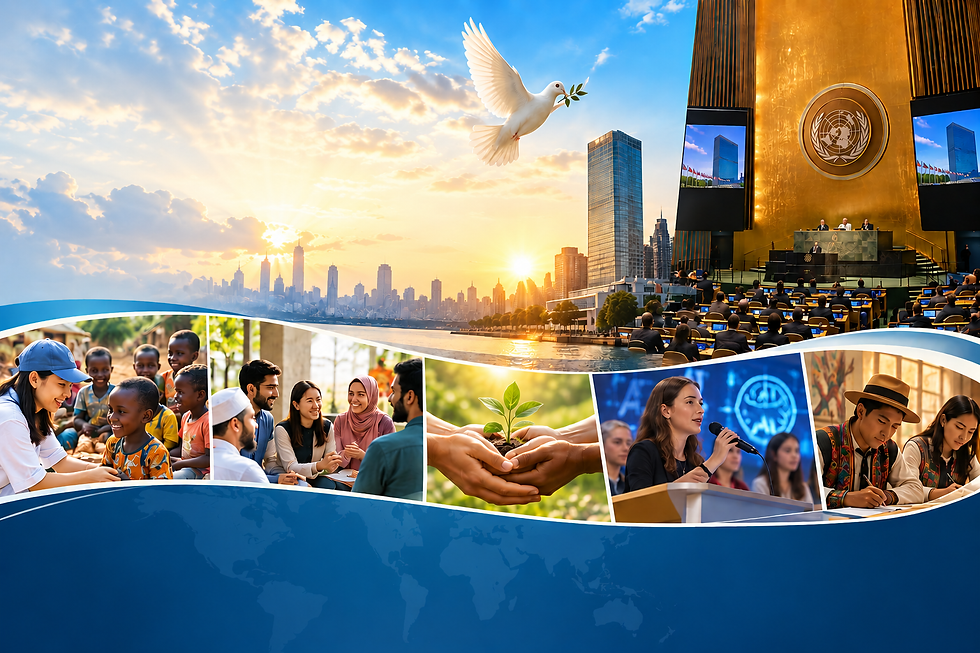
Vienna, Austria – Commemorating World Interfaith Harmony Week, on January 30, 2026, UPF-Europe and the Middle East, in cooperation with the United Nations Correspondents Association Vienna, the Coalition of Faith-Based Organizations (CFBO), Youth and Students for Peace (YSP) and the Women’s Federation for World Peace (WFWP), held a conference on the theme “The Relevance of Religions for a Peaceful World Order” at the UN Vienna International Center, with 200 guests in attendance.
Mr. Peter Haider, president of UPF-Austria, welcomed the participants and emphasized that World Interfaith Harmony Week, adopted by the United Nations, aims to promote understanding, mutual respect, and cooperation between people of different faiths. He noted that the conference's central theme was particularly significant at a time when the international system was showing clear signs of fragility. While underscoring that wars are not caused by religions themselves, but by political decisions, Mr. Haider highlighted the importance of interreligious dialogue as an ethical foundation for peace.
Dr. Afsar Rathor, former UN diplomat and vice president of CFBO, served as the moderator of the first session. He drew on his experience in conflict regions including Bosnia, Rwanda, Yemen, and the Middle East. He advocated an approach focused on inclusion, protection of minorities, and concrete public policies to promote peaceful coexistence. He warned of rising antisemitism, Islamophobia, attacks on Christian communities, and violence against migrants and other vulnerable groups.
Dr. Rathor presented international examples demonstrating how interreligious harmony can be translated into laws, budgets, institutions, and effective programs. Peace, he stressed, is not an abstract idea but a political and societal decision requiring long-term commitment.
Jordan’s ambassador to Austria and to the United Nations in Vienna, Amb. Mohammed Sameer Salem Hindawi, noted that World Interfaith Harmony Week was an initiative of King Abdullah II of Jordan, unanimously adopted by the UN General Assembly. He emphasized that religions, in their authentic essence, are forces of peace, justice, and compassion. The real challenge today, he stated, lies not in religious diversity, but in the deliberate distortion of religion for ideological or power-political purposes. Invoking God to dehumanize others or to justify the denial of fundamental rights is a betrayal of the religious message, he said.
Hon. Lukas Mandl, an Austrian member of the European Parliament, pointed out that religion is often perceived as a private matter in Western Europe, while worldwide the majority of people identify with a religious tradition. This makes religion a central factor for international understanding. Mr. Mandl emphasized the need to clearly distinguish between religion and its political misuse and warned that any religion can be instrumentalized if it is detached from human dignity and individual freedom. Peace, he argued, requires equitable relations between people, nations, and cultures. He also addressed the role of social media and algorithmic mechanisms in societal polarization, and warned of their addictive effects and their potential to undermine social and democratic cohesion.
Dr. Rizwana Abbasi, professor at the National University of Modern Languages in Islamabad, recalled her time in Great Britain, where she took part in numerous dialogues on social problems and their solutions. Today, she said, religions and cultures are more intertwined and disseminated through digital technologies. At the same time, social media can spread hate speech with religious messages. Therefore, she said, the EU initiative for intercultural dialogue is all the more important.
Prof. Jean-Luc Lemahieu, former director of policy and public affairs at the UNODC, recalled that at the beginning of the 21st century, the United Nations appeared to stand as a cornerstone of a rules-based international order founded on human rights and cooperation. However, in recent years, a gradual erosion of trust has set in, accompanied by the emergence of parallel initiatives that have called into question the central role of the United Nations. He emphasized that the UN's historical strength lay in its moral authority, its power to unite people, and their trust in its values. He defended interreligious dialogue as an essential element for restoring shared narratives, fostering trust, and supporting sustainable peace processes, particularly in conflict regions such as the Middle East.
The audience was treated to a musical interlude, presented by Dr. Joshua Sinclair, with performers Ms. Kirsten Wedeborn and Ms. Caroline Stevenson, who performed the songs “He Ain’t Heavy, He’s My Brother” and “The White Cliffs of Dover.”
Prof. Dr. Elmar Kuhn, international president of CFBO, reflected on the limitations of interreligious dialogue at the institutional level. He emphasized that high-level encounters lose their impact when they lack a connection to grassroots communities, where perceptions, prejudices, and attitudes are formed that directly shape coexistence. Dr. Kuhn warned that interreligious dialogue fails when it is reduced to proselytizing, confronting differences, or an idealized view that ignores real conflicts. Instead, he advocated for a reorientation toward concrete action: values education from early childhood, social cooperation, and a lived spirituality that strengthens respect for human dignity and diversity.
The Orthodox theologian and canon lawyer Dr. Androniki Barla analyzed the growing importance of religious diplomacy in an international environment characterized by a loss of trust in institutions and increasing identity-related conflicts. She pointed out that for decades, foreign policy has tended to relegate religion to the private sphere, a view that is no longer sufficient in light of a multipolar world order. Dr. Barla emphasized that religious leaders and organizations can contribute to mediation, reconciliation, and trust-building, particularly in fragile contexts where state structures have limits. She stressed, however, that this form of diplomacy is only effective if it is practiced responsibly, inclusively, and self-critically, without instrumentalizing faith and with the involvement of minorities, women, and youth.
Mr. Albert David, a member of the Anglican church and a Christian representative of the National Commission for Minorities in Pakistan, stated that religion, practiced authentically, is a force for peace, not conflict. Interreligious harmony does not mean eliminating differences, but rather respecting and valuing them as part of human diversity, grounded in shared values, such as dignity, compassion, and justice. He emphasized Pakistan's commitment to protecting religious minorities and rejecting extremism, while acknowledging existing challenges. He asserted that lasting peace is only possible when religions work together to defend human rights and transform diversity into a collective strength.
Ms. Matea Strkulová, coordinator of YSP in the Czech Republic, reported on the organization’s activities within the United Nations. She explained that there are 16 local groups in Europe and mentioned several events in Mitrovica, Kosovo (a scholarship program with Serbian participation) and the Czech Republic as unique opportunities for young people of different religions. She also presented other IAYSP projects, including the Peace Cup with football and other sporting events.
Mr. Jacques Marion, president of UPF-Europe and the Middle East and vice president of UPF-International, opened his speech by stating that peace cannot be achieved through political efforts alone. The United Nations must engage not only governments but also moral and spiritual resources to ensure lasting peace. He emphasized UPF's mission to support the United Nations and mentioned some past activities, such as bringing together political and religious leaders in Africa and preventing unrest through a year-long interfaith grassroots program in Solihull, near Birmingham.
Mr. Marion said that all religions share the call to conscience, rooted in the human heart. He pointed out that the world is witnessing the persecution of religious communities not only in authoritarian states but also, more subtly, in democratic societies. Mr. Marion recalled the first interfaith council of Bosnia and Herzegovina, established during the Bosnian War, which played an important role then as it does now.
The conference concluded with a joint appeal to reaffirm the role of religions as bridges of dialogue, sources of ethical values, and allies in defending human dignity. In light of the political instrumentalization of faith and the erosion of the multilateral order, participants agreed that interreligious dialogue, education, and cooperation between religious, political, and civil society actors remain indispensable on the path to a more just and peaceful world.
By Peter Haider, President, UPF-Austria January 30, 2026