The Human Foundations of Sustainable Development
Updated: Jul 10
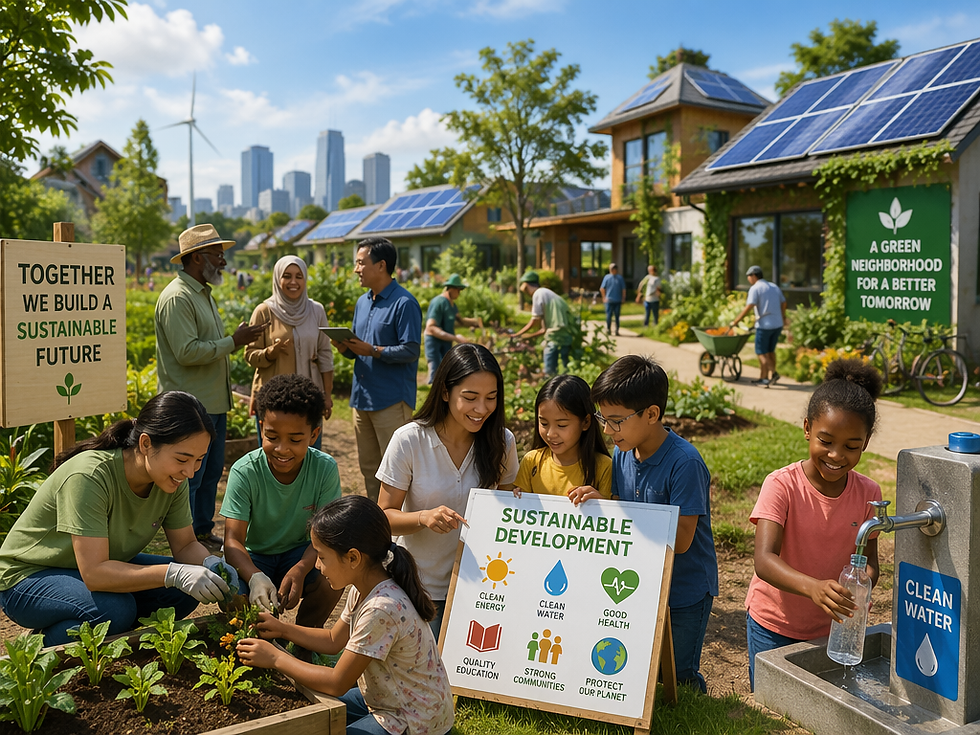
When a child can study after sunset because reliable electricity has reached the home; when a school has access to safe drinking water; when neighbors work together to protect a public space, sustainable development becomes tangible. It may be measured through policies, systems and indicators, but it is ultimately experienced in families, schools, neighborhoods and local communities.
As the High-Level Political Forum on Sustainable Development (HLPF) convenes at United Nations Headquarters in New York from July 7-15, 2026, governments are reviewing progress toward the 2030 Agenda for Sustainable Development. This year’s forum conducts in-depth reviews of Sustainable Development Goals related to clean water and sanitation, affordable and clean energy, industry, innovation and infrastructure, sustainable cities and communities, and partnerships.
These goals are often discussed in technical and policy terms, yet their impact is felt in daily life. Water systems depend not only on engineering but also on accountability, responsible management and local stewardship. Access to reliable energy shapes family life, education and economic opportunity. Infrastructure and innovation invite a deeper question: does technology truly serve the whole person and the common good? Cities become sustainable when residents can rely on safe housing, accessible services, public security and trusted local institutions. Partnerships endure when they are strengthened by honesty, service and mutual respect.
An important feature of HLPF 2026 is the presentation of Voluntary National Reviews (VNRs), through which countries report on their progress toward achieving the Sustainable Development Goals. These reviews demonstrate that while sustainable development is global in vision, it is implemented locally. Every country faces different circumstances, yet all share the same fundamental challenge: how can public commitments become measurable improvements in the lives of individuals, families and communities?
The Universal Peace Federation welcomes HLPF 2026 as an important United Nations process that promotes review, accountability, shared learning and international cooperation. We believe that lasting development grows from people, families and communities that practice responsibility toward one another and toward future generations.
Sustainable Development Goal 6 calls for clean water and sanitation. This is fundamentally a question of human dignity, health, the protection of children and reducing the daily burdens carried by families.
Sustainable Development Goal 7 promotes affordable and clean energy. Reliable energy transforms family life by expanding opportunities for education, productive work and fuller participation in society.
Sustainable Development Goal 9 encourages resilient infrastructure, sustainable industrialization and innovation. Innovation serves society best when guided by ethical purpose and when it expands opportunity for all rather than for only a few.
Sustainable Development Goal 11 seeks inclusive, safe, resilient and sustainable cities. A city is more than buildings and transportation networks. It is a living community of families, neighbors, schools, religious communities, local businesses, public institutions and civic organizations. Its sustainability depends upon whether children are protected, older persons remain connected, migrants are treated with dignity, families receive support, and public institutions earn the trust of those they serve.
Sustainable Development Goal 17, Partnerships for the Goals, is central to the entire development agenda. Effective partnerships require trust among governments, civil society, faith communities, the private sector, educators, youth and local leaders. Such trust is cultivated through consistent cooperation, transparent communication, ethical leadership and practical service. Through its worldwide network of UPF Ambassadors for Peace, UPF brings together leaders from diverse sectors to advance human dignity, civic responsibility and a culture of peace.
Although Sustainable Development Goal 16, Peace, Justice and Strong Institutions, is not among this year’s goals under in-depth review, its principles are indispensable to the success of the entire 2030 Agenda. Clean water systems, reliable energy, resilient infrastructure, sustainable cities and effective partnerships all depend upon institutions that are trusted, transparent, accountable and responsive to the people they serve.
Sustainable development flourishes where the rule of law is respected, integrity is upheld, public institutions are accountable, and leaders place the common good above narrow or partisan interests. Peaceful, just and inclusive societies provide the environment in which every other Sustainable Development Goal can take root and endure.
For UPF, the family is the first school of responsibility, cooperation and care. It is where children first learn whether promises are kept, whether elders are respected, whether conflicts can be resolved with wisdom rather than humiliation, and whether freedom is balanced by responsibility. Strong families contribute directly to children’s education, care for older generations, resilience during hardship and active participation in community life. Public policy and international cooperation remain indispensable, but their impact is greatest when they are rooted in relationships characterized by respect, self-discipline, service and genuine concern for others.
The founders of UPF, Dr. Hak Ja Han and the late Rev. Sun Myung Moon, have consistently emphasized the moral kinship of the entire human family and the responsibility that flows from it. Their vision invites nations, institutions and communities to view development as a shared responsibility, protecting human dignity, strengthening families, caring for the natural environment and expanding opportunities for all.
As HLPF 2026 proceeds, UPF encourages governments, United Nations agencies, civil society organizations, faith communities, educators, youth leaders and UPF Ambassadors for Peace to deepen cooperation around the human foundations of sustainable development. This commitment is also reflected in UPF Summer Events 2026, held under the public theme, “Restoring Trust: What Can Be Done for Peace Now?” The series invites UPF regions and partners to share practical examples from local communities and demonstrate how UPF’s vision of peace contributes to the global conversation in preparation for the opening of the 81st session of the United Nations General Assembly.
Water, energy, infrastructure, sustainable cities and effective partnerships advance most securely when they are supported by families that teach responsibility, communities that practice service, leaders who demonstrate integrity and institutions that recognize the inherent dignity of every human being. In this way, the practical goals of sustainable development are reinforced by a culture of peace, ethical leadership, strong institutions and public trust, enabling lasting progress for present and future generations.
In this spirit, the Universal Peace Federation remains committed to working in partnership with the United Nations and with all people of goodwill to build a more peaceful, just and sustainable future.
Dr. Tageldin Hamad, President, UPF-International July 7, 2026