


Webinar Addresses Declining Quality of Education in US Schools
Updated: May 3
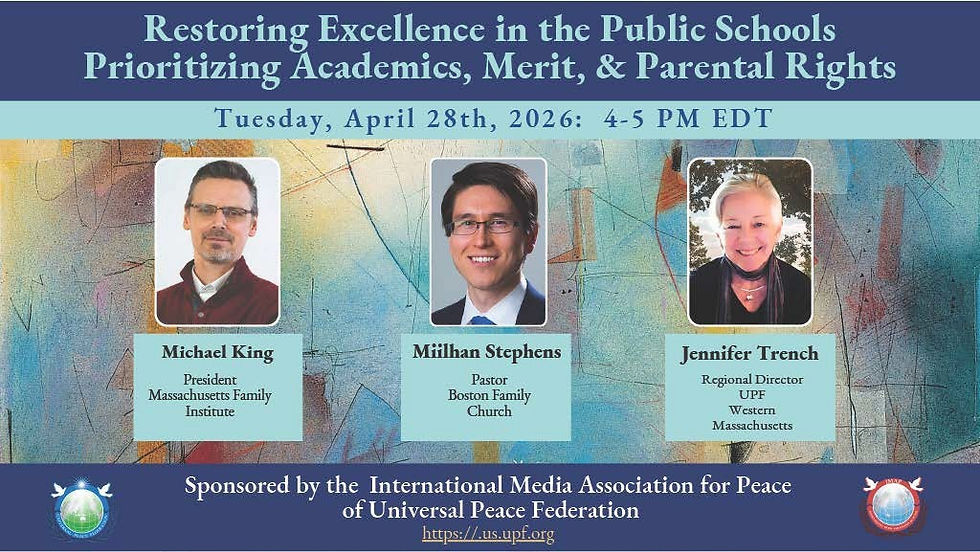
Boston, United States – The International Media Association for Peace (IMAP) USA sponsored a webinar on April 28, 2026, titled “Restoring Excellence in Public Schools: Prioritizing Academics, Merit and Parental Rights." It addressed rising concerns about declining academic performance, increasing ideological content in classrooms, and the erosion of parental influence in education. It was moderated by Ms. Jennifer Trench, executive director of UPF-Western Massachusetts, with guest speakers Mr. Michael King and Mr. Miilhan Stephens.
Speakers pointed to persistent drops in reading and math proficiency, alongside growing instructional time devoted to topics such as sexual identity and political ideology rather than core academics. A central theme was the need to restore parental authority. Participants highlighted the recent Supreme Court decision in Mahmoud v. Taylor, which affirmed parents’ rights anywhere in the U.S. school system to opt their children out of content that conflicts with their beliefs.
Keynote speaker Mr. Michael King, president of the Massachusetts Family Institute, shared effective strategies from Massachusetts. These include increased local engagement through school board elections, organized opt-out efforts, and the development of church-based learning centers – now more than 26 statewide, serving about 2,000 students. He also emphasized expanding school choice and strengthening community-based alternatives.
Pastor Miilhan Stevens offered a parent’s perspective, underscoring the importance of family values, flexibility and active involvement. He stressed “quality time” over “quantity time.” Drawing on his experience raising three children, he described navigating limited options through homeschooling and collaboration with like-minded families.
A major focus was Education Savings Accounts (ESAs), first introduced in Arizona in 2011 and expanded to universal eligibility in 2022. ESAs provide US$7,000–$11,000 per student in parent-controlled funds for tuition, tutoring and other services. By 2026, 18 states have adopted ESA programs, serving over 1.5 million students. The proposed Educational Choice for Children Act (ECCA), expected in 2027, would further support school choice through federal tax credits.
In conclusion, the webinar highlighted practical pathways to restore academic excellence and parental rights. Expanding school choice – particularly ESAs – offers families greater flexibility and aligns with UPF’s mission to strengthen families and support future generations. The webinar may be viewed at this link.


