


Restoring Trust Through Peace in Action: Reflections on UNGA 81
Updated: Oct 3
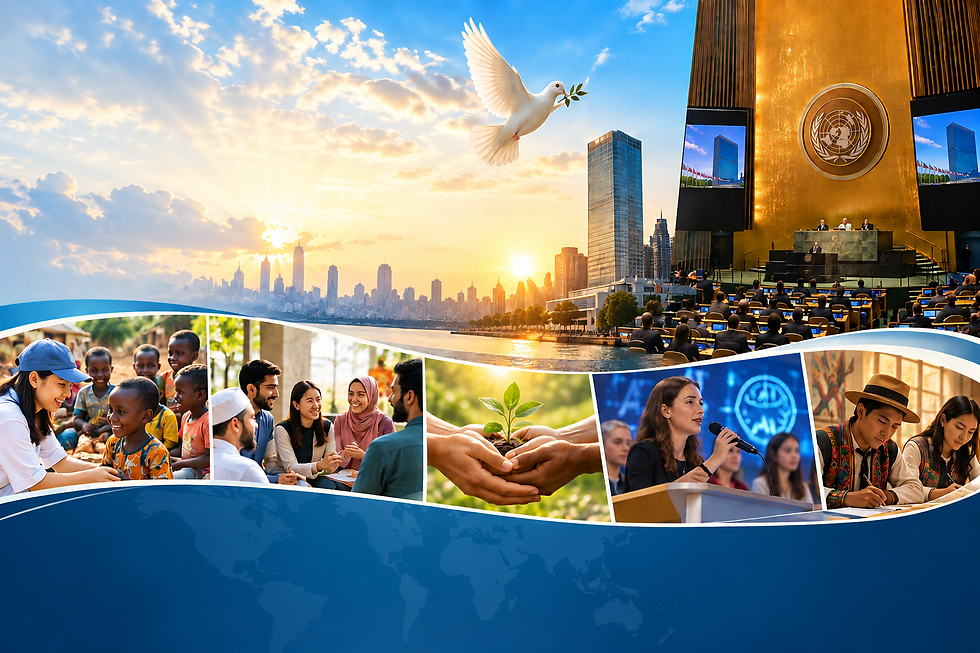
The General Debate of the 81st session of the United Nations General Assembly heard from 194 delegations, speaking from very different national and political perspectives about the world as they see it. Some disagreements were substantial, yet peace stood foremost among the concerns identified in the president of the General Assembly’s closing assessment. As I listened to those many voices, one question stayed with me: What can people reasonably count on after we have spoken?
Behind many of those speeches, I heard concern for people living with violence and hunger, for families struggling to afford what they need, and for communities uncertain about their future. It was a reminder that a lack of trust is experienced in ordinary life, not only between institutions and nations.
The session theme, “Restoring Trust, Managing Transformation: A United Nations That Delivers for All,” connected trust with keeping commitments, meaningful representation, accountability and results. What stayed with me was the practical meaning of those words. What will we do when the speaking is over?
For UPF, that question comes very close to home. After an event ends, do people know who will stay with the work? Do local voices continue to matter? Can a commitment be seen in what happens next?
A parent wondering whether a child will be safe, a young person searching for a meaningful place in society, or a neighbor carrying a burden we may not yet understand, gives these questions their human meaning. Before peace becomes a policy, it is experienced in such lives. Their concerns deserve patience, attention and respect. Listening to what people need, and also to what they can contribute, is where our responsibility begins.
From Restoring Trust to Peace in Action
During the summer, UPF chapters were asking a closely related question: “Restoring Trust: What Can Be Done for Peace Now?” In the months leading into the General Debate, chapters explored that question in ways suited to their own communities.
What was encouraging was the diversity of their answers. A common concern took on meaning in different local settings, and peace found a local vocabulary as people brought their own skills, traditions and relationships to the work.
Some answers began with service. Others began by giving people a responsibility that could continue after an event. In Australia, Religious Youth Service participants worked together at Minto Mosque and later gathered at a Hindu temple, combining service with interfaith encounter. In the Democratic Republic of the Congo, a Kinshasa conference established the national executive bureau of the International Association of Parliamentarians for Peace, giving dialogue a structure and people who could carry it forward. In August, that bureau met again and adopted a roadmap for what would come next. I find value in both approaches because they lead us to the same gentle but important question: After goodwill is expressed, what will help it endure?
Other programs reminded us that peace also requires imagination and careful judgment. In Peru, an international writers’ congress brought poets and writers into reflection on peace through literature and cultural imagination. In the United Kingdom, a youth leadership session examined deepfakes, misinformation and ethical uses of artificial intelligence, inviting participants to consider what these questions mean for conflict resolution and for their own lives. In the United States, a Washington, D.C. IAPD gathering brought women from different professions, faiths and cultural backgrounds together to reflect on mutual support, understanding and responsibility for one another in family, work and community life.
That conversation felt especially timely during a General Debate in which the General Assembly president reported that 128 delegations addressed artificial intelligence. Peacebuilding now reaches into the stories we tell, the information we trust, and the technologies that increasingly shape how we see one another.
These programs did different kinds of work. Some addressed an immediate practical need; others opened conversations or organized people for future cooperation. A report can tell us what happened that day. Trust takes longer.
I would like us to remain attentive to what happens afterward. Who continues the conversation? Who takes responsibility for the work? How do the people concerned describe its value? These questions help us appreciate what has begun while recognizing what still needs care.
Keeping the Person at the Center
This attention to the person is close to the vision of UPF founders Dr. Hak Ja Han and the late Rev. Sun Myung Moon, expressed in the understanding of humanity as one family under God.
For me, that vision carries a responsibility to approach every person as someone whose life matters. It asks us to widen our concern beyond those with whom we already feel comfortable. Across differences of belief, culture, nationality and background, we can honor human dignity through the care we give and the respect with which we receive another person’s contribution.
Dignity also means having something to contribute. Someone receiving help may also have knowledge, skill and generosity to offer. A community understands dimensions of its own experience that an outside visitor has yet to learn.
UPF wants service to make room for this contribution. People should have opportunities to help shape decisions that affect them, while cooperation strengthens their capacity to care for one another. For me, this is one true meaning of mutual prosperity: progress in which the wellbeing of others matters to our own.
The same UN high-level week offered another reminder. At the commemoration of the fortieth anniversary of the Declaration on the Right to Development, attention returned to a principle expressed in the Declaration: people belong at the center of development, participating in it and benefiting from it. For our own work, I take this as a reminder to keep asking: Who has a voice when a project is chosen, and does that voice continue to matter as the work grows?
The high-level meeting on sea-level rise offered another illustration of our interdependence. Disruption to ports and transportation can affect food prices, medicines and household budgets far from the coast. Protecting homes, livelihoods and heritage also concerns the world we leave to our children and grandchildren.
Interdependence becomes easier to understand when we see how a distant disruption can enter a household. It can carry hardship across borders; cooperation is the responsibility we bring to that connection.
Local care and wider responsibility therefore belong together. Peace has a better chance to endure when people can make their experience heard and when wider commitments become something they can depend upon in daily life. UPF can help people with different responsibilities stay in conversation around a real need, and give those relationships enough time to become useful and trustworthy.
Investing in Peace
With the General Debate complete, our attention now turns to UPF’s October–December 2026 Year-End Focus “Invest in Peace: From the Family to the Nation, From the Nation to the World.” The programs of recent months have shown us how much goodwill and creativity already exist. I hope this next period helps us care for what has begun, so that promising relationships can find a responsible local home, continue beyond a single gathering, and grow through partnership without losing sight of the people they are meant to serve.
The Year-End Focus begins with the family for a reason. Peace is first encountered in close relationships, where we learn to listen, to care, to forgive and to repair what has been hurt. From there, responsibility can widen naturally into communities, civic networks, partnerships and public life. The habits learned close to home can become part of how we meet one another in the wider world.
Through this Year-End Focus, we are inviting national chapters and their partners to carry at least one useful local program into 2027. Where good work is already serving people, it deserves care and continuity. Elsewhere, a modest beginning may be enough. The important thing is to respond to a need the community itself recognizes, at a scale those involved can sustain. By the end of the year, I hope more people will be able to point to work they helped shape and know who will continue it with them.
UPF Ambassadors for Peace can contribute their experience and relationships from the beginning. A partner may know which local organization is already addressing a need, or which person has been left out of the conversation. Young colleagues may see possibilities that established leaders have missed.
We welcome this contribution both in choosing the work and in accepting responsibility for carrying it forward. And if an approach proves less useful than expected, listening again and changing course can itself be an expression of respect for those we hope to serve.
Carrying the Work into 2027
Looking toward 2027, I hope UPF International can help good local efforts find wider expertise, partners and appropriate support without taking away the knowledge and ownership of the people closest to the work. One community can also learn from another, including from what did not go as planned. When such learning is shared with humility, a useful local effort can encourage peacebuilding elsewhere while remaining faithful to the people who gave it purpose.
The years ahead invite us to think beyond our immediate work. The General Assembly has proclaimed the International Decade of Strengthening of Peace for Future Generations, 2027–2036. I find in this a quiet but important question for UPF as well:
What will our choices today make possible for those who come after us?
The habits formed through a continuing project, the trust created through service, and the relationships that sustain cooperation can become part of what one generation entrusts to the next. Younger people therefore belong within this responsibility now. They can help design initiatives, work with partners and take part in assessing what those initiatives achieve. Experienced colleagues can accompany them with patience while allowing room for initiative, creativity and learning.
A young person entrusted with meaningful responsibility has an opportunity to discover how conviction becomes service, how leadership requires listening, and how cooperation can survive disagreement. That experience gives substance to our concern for future generations.
UPF welcomes partners who want to help grassroots peacebuilding grow with patience and care. As we plan for 2027, peace in action for future generations gives us a purpose worth carrying with humility and determination.
Those who follow us will inherit not only the problems still awaiting answers, but also the ways we have learned to cooperate. My hope is that they will inherit communities in which people know how to listen across differences, institutions worthy of their trust, and examples that remind them that caring for one another and building peace together are still possible.
Dr. Tageldin Hamad, President, UPF International October 1, 2026


