


IMAP Examines State of Religious Freedom Worldwide
Updated: Jul 30
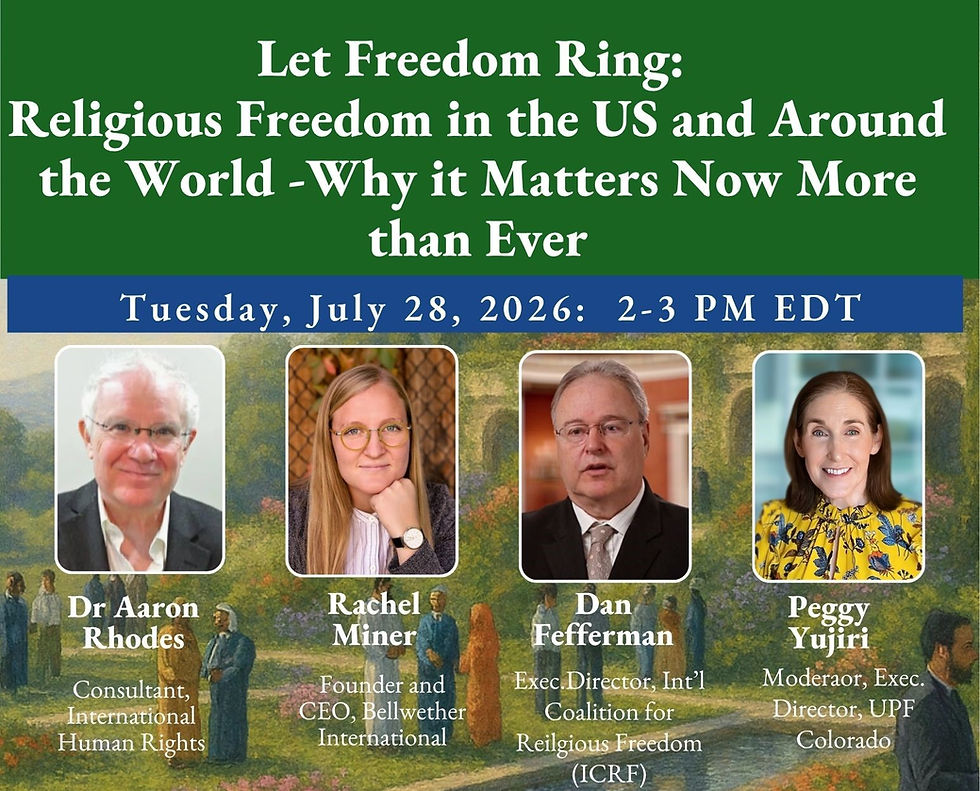
IMAP, United States – The International Media Association for Peace (IMAP) convened its monthly webinar on July 28, 2026 to examine the state of religious freedom domestically and globally. The program, titled "Let Freedom Ring: Religious Freedom in the US and around the World: Why it Matters Now More than Ever" was hosted by Ms. Peggy Yujiri, executive director of UPF-Colorado. The session featured three panelists: Dr. Aaron Rhodes, Ms. Rachel Miner, and Mr. Dan Fefferman.
Dr. Aaron Rhodes, human rights author and former executive director of the International Helsinki Federation for Human Rights, opened by arguing that religious freedom underpins American pluralism and its unmatched network of higher education institutions, many rooted in denominational seminaries. He traced this to the U.S. founders' belief in "natural rights" – freedoms inherent to all people rather than granted by government.
Dr. Rhodes warned that this concept has faded from civic and human rights discourse, replaced by a "positivistic" view tying rights solely to treaties and legislation. He rejected Christian nationalism as unconstitutional and discriminatory, and criticized the international human rights system for treating all rights as equally weighted, which he says obscures the centrality of religious freedom to democracy itself.
Ms. Rachel Miner, executive director of Bellwether International, connected religious freedom to genocide prevention, noting that identity-based hatred – often rooted in religious differences – remains a leading driver of atrocities worldwide. She shared the stories of two peacemakers: Miriam, a young Muslim woman in Nigeria who organized interfaith school exchanges between Christian and Muslim students; and Nishman, a Yazidi genocide survivor in Iraq who launched a sewing enterprise to rebuild interreligious economic trust after ISIS atrocities.
Ms. Miner emphasized the "proximity principle" – that direct contact reduces hatred between different groups – and urged listeners to be "bellwethers" who model tolerance personally and economically. While she is encouraged by the growth of religious freedom coalitions worldwide, she also flagged rising domestic threats in the United States, including a fragmented civil society that is ill-prepared to counter actions by authoritarian states.
Mr. Dan Fefferman, a longtime human rights educator, offered a historical overview of U.S. religious liberty, from the Constitution's ban on religious tests for office through the Bill of Rights, to 14th Amendment-era rulings extending protections to the states. He outlined ongoing debates including proselytizing rights, public religious displays, and equal treatment for Muslim Americans.
Mr. Fefferman presented four global models of church-state relations: the U.S. (neutral) model, the European (state-favored church) model, the Chinese (state-suspicious/atheist) model, and the Islamic (state religion) model. He closed by voicing concern over democracies adopting more restrictive postures, citing Japan's dissolution of the Unification Church and South Korea's imprisonment of Dr. Hak Ja Han as troubling signs of the "Chinese model" spreading to liberal democracies.
During the discussion that followed, Dr. Rhodes addressed rising antisemitism in Europe and the United States, and the reluctance of human rights bodies to defend controversial minority faiths. Mr. Fefferman noted media's dual role, expanding tolerance through coverage while sometimes amplifying conspiracy theories and polarization.
The panel closed with a shared call to action, saying that individuals and communities must actively practice and defend religious pluralism, both at home and abroad.
By Peggy Yujiri, Executive Director, UPF-Colorado July 28, 2026


