


April 1990 in Moscow:
Dialogue Across
the Iron Curtain


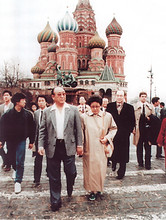
In the final months of the Cold War, Moscow witnessed scenes that would have seemed implausible only a few years earlier. In April 1990, Dr. Sun Myung Moon and Dr. Hak Ja Han, widely known for their principled opposition to Marxist Leninist ideology, were welcomed in the Soviet capital and received by the highest levels of Soviet leadership. Inside the Kremlin, they met personally with President Mikhail Gorbachev. At the same time, Moscow hosted a large international conference organized with official Soviet cooperation, while a Korean children’s ballet performed before Soviet audiences and the First Lady of the USSR. These events, unfolding over several days, formed a coherent message. They demonstrated that even at the height of ideological division, dialogue, cultural exchange, and human contact could open doors that politics alone had kept shut.
Dr. Moon and Dr. Han were the founders of what would later become the Universal Peace Federation, an international civil society organization dedicated to dialogue, cooperation, and peacebuilding across political, cultural, and national boundaries. Their Moscow visit in April 1990 embodied the method that would later define UPF’s work: engage rather than isolate, criticize ideas without rejecting people, and build bridges where confrontation had long prevailed.
Why these Moscow Events Were Possible in 1990
By the spring of 1990, the Soviet Union was undergoing rapid and visible transformation. Under Pres. Gorbachev’s leadership since 1985, his perestroika and glasnost policies had loosened longstanding controls on public life. Censorship was eased, political debate became more open, and economic reforms introduced limited market mechanisms. In 1989, competitive elections were held for a new legislature, and throughout Eastern Europe communist governments collapsed without Soviet military intervention. The opening of the Berlin Wall in November 1989 symbolized a broader shift that was already reshaping Europe.
Internationally, relations between the Soviet Union and the West were warming through arms reduction agreements and new channels of cooperation. The April 1990 meeting in the Kremlin took place only months before the final settlement on German reunification and shortly before the Soviet Union moved to establish full diplomatic relations with the Republic of Korea, steps that would decisively reshape Europe and Northeast Asia. Pres. Gorbachev’s decision to renounce the use of force in Eastern Europe marked a decisive break with earlier doctrine and earned him growing international respect. In this environment, the Kremlin became increasingly open to engagement with nongovernmental actors, including voices that had once been regarded as adversarial.
A Vision Long Articulated
Dr. Moon had spoken publicly for many years about the need to engage the communist world directly. As early as October 1976 in the USA, at the height of the Cold War, he declared that Moscow would one day be a destination for dialogue. At the time, such a statement seemed unrealistic. Yet by the late 1980s, the internal changes underway in the Soviet Union made that vision possible.
Dr. Moon was widely associated with strong critiques of communism as a materialist system that restricted freedom of conscience and undermined human dignity. Through educational initiatives and public advocacy, Dr. Moon promoted alternatives centered on freedom, responsibility, and universal moral values. At the same time, he consistently drew a distinction between opposing an ideology and rejecting the people who lived under it. His aim was to challenge ideas, not to dehumanize societies.
That distinction shaped the approach taken in Moscow. The visit was not framed as a victory lap over a weakening system, but as an invitation to dialogue at a moment of historic transition.
Laying the Groundwork Through Media Dialogue


Before April 1990, contacts had already been developing across the Iron Curtain. The World Media Association established by the UPF founders was conceived as a space of deliberately low political temperature, where journalists could speak about change without the pressure of official positions or ideological declarations. It functioned as an environment in which professional ethics and shared responsibility gradually replaced mutual suspicion, using journalism itself as a means of reducing longstanding demonization. Through the World Media Association, founded to promote dialogue among journalists and media leaders, delegations of Western journalists began visiting the Soviet Union in the early 1980s. These exchanges were reciprocal. Soviet journalists traveled to the United States, Japan, and South Korea, observing open media environments and engaging in professional discussions with their counterparts.
By the late 1980s, major Soviet outlets such as TASS, Novosti, Pravda, and Izvestia were participating cautiously in these exchanges. Soviet editors attended World Media Association conferences abroad, including the March 1989 conference in Washington, where a group of prominent Soviet journalists took part. These encounters helped replace caricatures with personal relationships and built a foundation of trust that later made a large international conference in Moscow politically feasible.
The 11th World Media Conference in Moscow


The centerpiece of the April 1990 visit was the 11th World Media Conference, held in Moscow from April 9 to April 13 under the theme “The International Influence of Glasnost and Perestroika.” The conference was co-organized by the World Media Association and the Soviet Novosti Press Agency, with official approval and cooperation from Soviet authorities.
The scale of the gathering was unprecedented for an independent international conference in the Soviet capital. Approximately one thousand participants attended, including journalists, scholars, civic leaders, and political figures from around the world. Among them were forty-one current or former heads of state and government. The delegation included leaders from Europe, Asia, Africa, and the Americas. From Latin America alone, participants included former presidents Mr. Oscar Arias of Costa Rica, Mr. Vinicio Cerezo of Guatemala, Mr. Osvaldo Hurtado of Ecuador, and Mr. Julio María Sanguinetti of Uruguay, reflecting the strong involvement of the Association for the Unity of Latin America.
Parallel to the media conference, related gatherings included the Summit Council for World Peace, which brought together former heads of government, and the ninth international conference of the Association for the Unity of Latin America. This broadened the scope of the Moscow meetings beyond East-West relations, incorporating perspectives from the Global South on democracy, development, and international cooperation.
Soviet officials took an active public role. Mr. Yuri Ossipyan, a senior member of the Presidential Council, welcomed participants on behalf of the Soviet leadership, and Novosti chairman Mr. Albert Vlasov served as a principal liaison. Soviet audiences responded with curiosity and engagement. Only a few years earlier, open international conferences of this scale would have been unthinkable in Moscow. The presence of dozens of former heads of state created a powerful impression, and for many Soviet journalists, students, and young professionals, the conference became a rare window onto the wider world, experienced not through ideological messaging but through direct conversation and personal contact. For many, this was their first experience of an open international forum with such a diverse global presence.
Dr. Moon addressed the conference with words of encouragement for the reforms underway, expressing confidence in a moral and social renewal for Soviet society. He praised Pres. Gorbachev’s courage and urged that political and economic change be accompanied by a deeper renewal of values. The conference attracted significant domestic attention. The main Soviet television news program, Vremya, reported on the World Media Conference as one of the important international events of the week, signaling that the leadership regarded it as relevant for the entire Soviet Union, not merely a niche foreign gathering.
April 11, 1990: Dialogue in the Kremlin


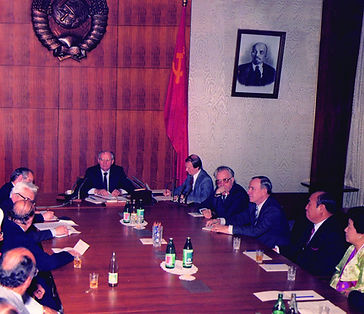
The most symbolic moment of the visit came on April 11, when Pres. Gorbachev received Dr. Moon, Dr. Hak Ja Han, and international delegates in the Kremlin. For Soviet observers, it was also striking to see Dr. Hak Ja Han playing an active and visible role in an international initiative of this scale, at a time when female leadership in global civic affairs was still rarely highlighted in the Soviet public sphere. Soviet news agencies reported that the president described the gathering as an important element of cooperation between the Soviet Union and the wider world. Major newspapers and television devoted prominent coverage to the meeting.
Although the meeting took place within the formal setting of the Kremlin, it did not follow the rigid protocol typical of earlier decades. The atmosphere reflected a time of transition, when established diplomatic rituals were giving way to more open and personal exchanges. Pres. Gorbachev was meeting not only official state representatives but also civic leaders and international figures whose influence lay outside traditional government channels, a sign of how fluid and experimental Soviet diplomacy had become by 1990. First, Pres. Gorbachev met Dr. Sun Myung Moon, Dr. Hak Ja Han, and a group of dignitaries, including twenty-eight former heads of state and government. The atmosphere was relaxed and cordial. Dr. Moon opened with a personal compliment about Pres. Gorbachev’s appearance, drawing laughter and easing the tone. He then stated clearly that the purpose of the gathering was to support and better understand perestroika and glasnost and to communicate their significance internationally.
A ceremonial exchange followed. Dr. Moon presented Pres. Gorbachev with a white marble vase from Korea engraved with a dragon motif, symbolizing prosperity and honor. Pres. Gorbachev accepted the gift with humor and appreciation, thanking the delegation warmly.
After this larger meeting, Pres. Gorbachev extended an unusual personal courtesy by inviting Dr. Moon and Dr. Hak Ja Han into his private presidential office, accompanied by a small number of aides and interpreters. This space was rarely opened to foreign visitors. Inside, with the symbols of Soviet history visible around them, the conversation became more direct.
Dr. Moon emphasized two themes. First, he argued that reform would be incomplete without genuine freedom of conscience and respect for spiritual life. He encouraged the development of what he described as a moral or spiritual dimension to perestroika, alongside institutional reform. Second, he spoke about the Korean Peninsula, urging normalization of relations between the Soviet Union and the Republic of Korea and encouraging a meeting with President Roh Tae-woo.
Pres. Gorbachev listened attentively. He acknowledged that his own thinking about religion had evolved, including following his meeting with Pope John Paul II in December 1989. About Korea he responded positively, stating that normalization with South Korea was only a matter of time and expressing his desire to meet President Roh Tae-woo. Events later that year moved quickly. In June 1990, Pres. Gorbachev and Pres. Roh held a summit meeting, and on September 30, 1990, the Soviet Union and the Republic of Korea formally established diplomatic relations.
The meeting concluded on a warm note. Pres. Gorbachev joked that The Washington Times sometimes caused him difficulties, and Dr. Moon replied that the newspaper supported openness and reform and that criticism was intended constructively. Pres. Gorbachev thanked the delegation in Russian and complimented Dr. Hak Ja Han on her Korean attire.
April 12, 1990: Cultural Exchange Through the Little Angels


If the Kremlin meeting highlighted political dialogue, the following evening demonstrated the power of culture. On April 12, the Little Angels Children’s Folk Ballet of Korea performed at the Natalia Sats Children’s Musical Theater in Moscow. Founded by Dr. Moon and Dr. Han in 1962, the Little Angels had long served as cultural ambassadors, presenting Korean traditions around the world.
The Soviet First Lady, Raisa Gorbacheva, attended the performance as guest of honor, leaving another official engagement to do so. The program featured Korean traditional dances in colorful hanbok costumes, as well as Russian folk songs sung with careful pronunciation. The audience responded with sustained applause and repeated calls for encores. The program included a performance of the beloved Russian song Moscow Nights, which resonated deeply with the audience.
The evening also coincided with Dr. Moon and Dr. Hak Ja Han’s thirtieth wedding anniversary. The Little Angels brought out an anniversary cake, and the couple was invited on stage to celebrate, with First Lady Raisa Gorbacheva joining them. At the end of the performance, she waved to the children and called out affectionately in English, “My Little Angels, bye bye.” She later praised the troupe, saying, “I have never seen such disciplined beauty in my life. It’s almost like my girlhood dream coming true.”
The performance exemplified cultural diplomacy at its most effective. Through music and dance, it humanized relations between societies that had long viewed each other through ideological lenses. It also anticipated the diplomatic normalization between the Soviet Union and South Korea that would follow later in the year.
Aftermath and Continuing Engagement
The April 1990 visit was followed by expanded exchanges. Soviet authorities showed growing interest in sending officials, journalists, and students abroad for leadership and educational programs associated with Dr. Moon’s initiatives. Delegations of deputies from the Supreme Soviet traveled to the United States later in 1990, and in 1991 a World Leadership Conference in Washington brought together nearly two hundred Soviet regional and national leaders.
Student exchange programs expanded rapidly. By early 1991, reports indicated that approximately 1,400 Soviet students had already participated in overseas programs, with another 1,600 scheduled within the year. Soviet institutions facilitated these exchanges as opportunities for young people to experience open societies and international dialogue. Thousands of students gained exposure to new ideas and formed personal connections that outlasted the Soviet system itself.
The relationship formed in Moscow also endured. In November 1994, after leaving office, the former President Mikhail Gorbachev visited South Korea and met Dr. Moon again in Seoul, underscoring the personal rapport established during the historic meeting in 1990.

Legacy
The Moscow visit of April 1990 stands as a distinctive episode in the peaceful conclusion of the Cold War. Dr. Sun Myung Moon and Dr. Hak Ja Han combined an unprecedented international conference, direct dialogue with Soviet leadership, and a powerful cultural program into a single initiative. Their approach demonstrated that engagement, candid conversation, and cultural exchange could soften even the most entrenched divisions.
This experience later informed the work of the Universal Peace Federation, founded in 2005, which adopted dialogue, media responsibility, and bridge-building as core principles. As the Cold War receded, the task evolved from breaking through barriers to taking responsibility for what followed: from dialogue between systems to dialogue between societies, and from competing narratives to a shared vision of peace. Dr. Hak Ja Han’s later establishment of the International Media Association for Peace as part of UPF reflected this shift, carrying forward the spirit of the World Media Association into a new global context.
Following the passing of her husband, Dr. Hak Ja Han ensured that the spirit and purpose of the Summit Council for World Peace did not fade with the end of the Cold War era. She initiated the creation of the International Summit Council for Peace within the structure of UPF, to carry forward the idea of convening current and former heads of state, senior policymakers, and global leaders in an independent civic framework. While the historical context had changed, the core objective remained consistent: to provide a space where experienced political leaders could speak candidly, beyond immediate national interests, and contribute their wisdom toward conflict prevention, reconciliation, and long-term peace. Through ISCP, the legacy of the Summit Council evolved from a Cold War bridge-building initiative into a continuing mechanism for dialogue in a multipolar and interconnected world.
April 1990 in Moscow remains a human story of an encounter at a turning point in history: a Soviet president and two global civil society leaders meeting face to face inside the Kremlin as the Iron Curtain began to lift. The events did not end the Cold War by themselves, but they reflected and reinforced a broader transformation, showing that even deep ideological divides can be crossed when dialogue replaces isolation.